The growing complexity of IT environments, the popularity of remote work, and migration to the cloud mean that organizations need a new approach to security and network management. SASE addresses these challenges by integrating networking capabilities with advanced security protection. In this article, we explore practical SASE use cases that support the day-to-day operations of modern businesses. We also examine leading tools available on the market that enable organizations to implement this approach across different business scenarios.
What Is SASE?
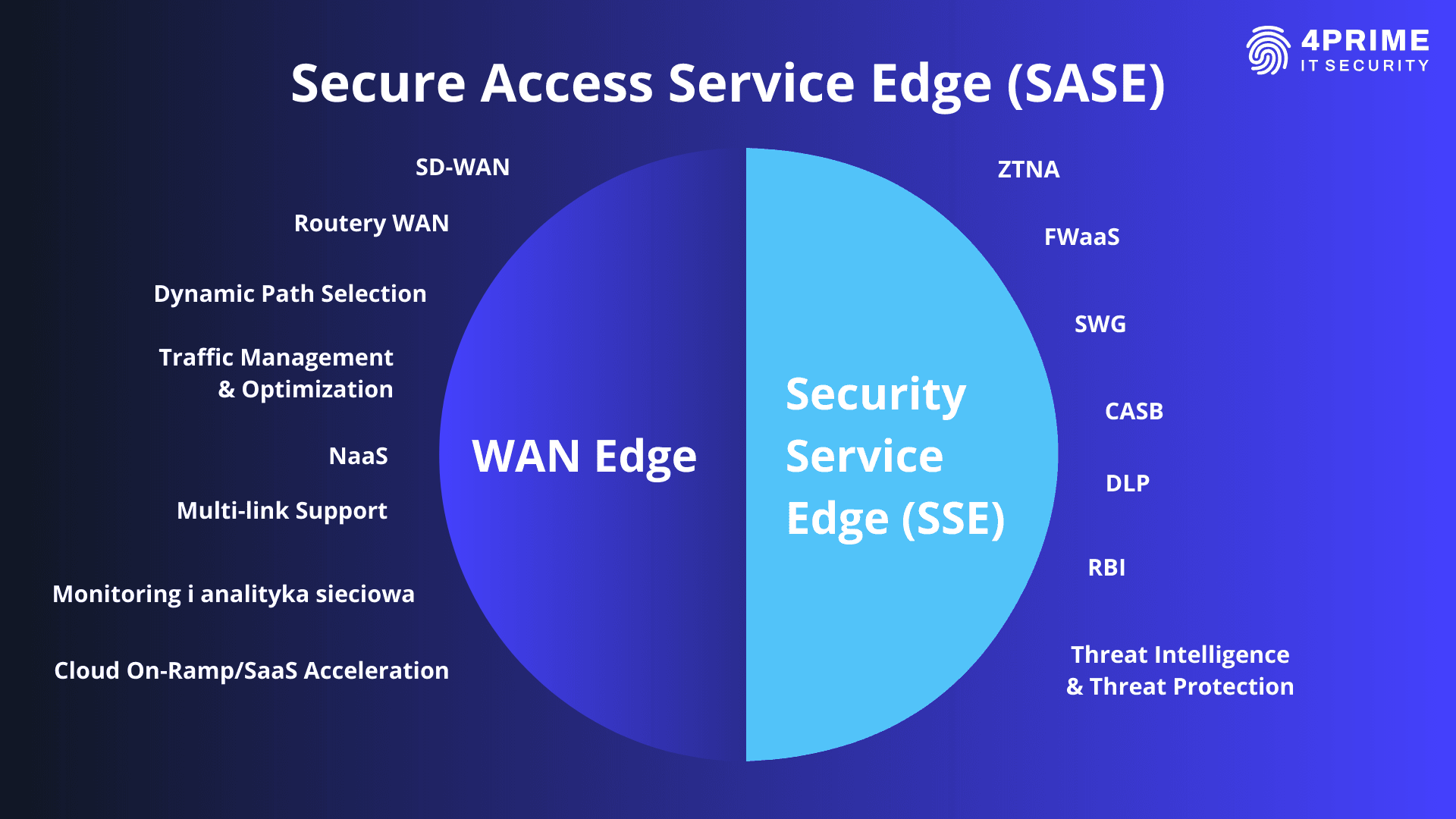
SASE (Secure Access Service Edge) is a modern security architecture that combines networking and security functions into a single, integrated solution tailored to the needs of organizations using applications and cloud resources, as well as traditional data centers.
SASE consists of two main components:
WAN Edge, the networking component responsible for establishing fast, reliable connections between users and applications, as well as monitoring those connections.
SSE (Security Service Edge), the security component that includes technologies such as Secure Web Gateway, CASB, DLP, and Zero Trust Network Access (ZTNA).
SASE enables organizations to provide efficient and secure access to cloud resources from anywhere, centrally manage security policies, and overcome the limitations of traditional solutions such as VPNs and firewalls. SASE plays a particularly important role in distributed environments and amid the growing popularity of remote work.
A glossary of all SASE components can be found at the end of this article.
Practical SASE Applications – Use Cases
1. Network Management in Distributed Environments
SASE is particularly effective for organizations with multiple branches, both nationally and globally. Through SD-WAN integration, companies can efficiently manage their networks and access to applications and resources, even when they are hosted on different servers and in different locations, including the cloud.
Furthermore, SASE helps maintain consistent security policies regardless of where users work and enables organizations to respond quickly to security incidents or changing business requirements.
2. Reducing the Load on Firewalls
Without SASE, organizations may route all network traffic through a central firewall to improve connection security. In large organizations with distributed teams, this can overload devices, increase latency, and negatively affect the user experience.
SASE reduces the load on firewalls by providing users with direct, secure access to cloud applications without requiring all traffic to be continuously tunneled through central locations. Additionally, through ZTNA mechanisms, SASE improves the security of communication between users and applications hosted in corporate data centers.
This approach not only simplifies infrastructure but also reduces costs, improves application responsiveness, and provides stronger protection.
3. Cloud Security
When an organization moves most of its resources and tools to the cloud, such as Microsoft 365, Google Workspace, or AWS S3, effectively securing access to these applications and data becomes essential.
SASE enables granular access control across cloud environments, user activity monitoring, implementation of DLP (Data Loss Prevention) policies, and detection and blocking of unauthorized activities through components such as CASB, SWG, and Threat Intelligence.
This gives organizations greater confidence that sensitive data remains protected regardless of where users connect from or which devices they use.
4. BYOD (Bring Your Own Device)
In environments where employees use their own laptops, smartphones, or tablets, protecting corporate resources becomes particularly challenging.
SASE addresses these needs by enabling the deployment of security agents, implementing different policies for personal devices (such as restricting access, requiring active EDR or antivirus software, or enforcing disk encryption), and monitoring and managing user sessions.
As a result, even in BYOD environments, companies maintain visibility and control over who accesses corporate data, how they access it, and which resources they are authorized to use.
This approach effectively reduces the risks associated with personal devices without sacrificing flexibility for users.
5. Protection Against Internet-Based Threats
One of the biggest challenges facing modern businesses is protecting against internet-based threats such as phishing, malware, ransomware, and data breaches.
SASE integrates mechanisms such as Secure Web Gateway, Threat Intelligence, DLP, and UEBA to detect and block malicious websites and files, analyze user behavior, and protect valuable data against loss or unauthorized disclosure.
These systems continuously update their threat intelligence databases and automatically respond to emerging security incidents.
6. Remote Work
In companies where remote and hybrid work has become the norm, SASE is a key solution for providing secure and convenient access to applications and cloud resources from any location.
It eliminates the need to rely on traditional VPNs, which typically authenticate users only when establishing a connection.
Through ZTNA, SASE enables continuous authorization, user activity monitoring, and immediate responses to potentially dangerous behavior.
Remote employees can access corporate tools seamlessly and efficiently while maintaining secure data transmission.
Leading SASE Solutions
Netskope
Netskope is one of the leading providers in the SASE market, offering a platform focused on securing access to cloud applications, the internet, and distributed work environments.
Its core capabilities include advanced CASB (Cloud Access Security Broker), a modern Secure Web Gateway (SWG), Data Loss Prevention (DLP), Zero Trust Network Access (ZTNA), and a Threat Intelligence engine.
Netskope enables highly granular policies for access to cloud applications and data, detects shadow IT, and protects network traffic regardless of where users connect from.
The platform also supports SD-WAN and simplifies comprehensive security management through a single centralized console.
Netskope emphasizes detailed reporting and contextual analysis, allowing organizations to respond dynamically to unusual user activity.
Prisma SASE
Prisma SASE by Palo Alto Networks is a comprehensive, integrated platform combining advanced SD-WAN capabilities with sophisticated Security Service Edge (SSE) functions, including ZTNA, Firewall as a Service (FWaaS), SWG, CASB, DLP, and threat prevention.
Prisma protects users, applications, and devices regardless of location, with an emphasis on fast access, complete traffic visibility, and centralized policy management.
One of the platform's distinctive advantages is its use of artificial intelligence to automate threat responses and enable dynamic, adaptive protection.
The solution also offers extensive integration with other Palo Alto Networks tools, such as Cortex XSOAR, alongside advanced features supporting regulatory compliance and security audits.
Prisma SASE also stands out for its high performance and reliability in both remote and hybrid work environments.
Cloudflare
Cloudflare offers a SASE platform built on its own global infrastructure, known for low latency and high availability.
Cloudflare provides a unified service that includes ZTNA ("Access"), SWG, Firewall as a Service, CASB, DLP capabilities, and Threat Intelligence integration. All these services operate within the Cloudflare cloud, which acts as an edge proxy.
The solution is distinguished by its simple and flexible implementation, centralized management through an "as a service" model, rapid scalability, and availability across more than 300 locations worldwide.
Cloudflare places particular emphasis on simplifying security policy management and providing transparency and real-time visibility into security incidents.
The platform is especially valued by DevOps and IT teams for its intuitive tools and Cloudflare's extensive experience in effective DDoS protection.
Fortinet
Fortinet offers its SASE solution as an extension of its flagship Security Fabric platform.
FortiSASE integrates a cloud-based version of its firewall (FortiGate NGFW), SWG, ZTNA, CASB, DLP, and advanced SD-WAN capabilities.
FortiSASE is particularly well suited to organizations operating both on-premises and hybrid or cloud infrastructure.
Fortinet is also known for high performance, process automation (including incident response through FortiAnalyzer), and an extensive integration ecosystem.
The platform enables centralized management of access and security policies through a single console and provides strong support for regulatory compliance, making it particularly attractive to large enterprises and financial institutions.
If you want to strengthen the security of your cloud applications, contact our expert to find out which SASE solution best addresses your company's needs.
Key SASE Components – Glossary
All SASE components can be configured and controlled through a single, intuitive platform, typically hosted in the cloud.
This gives administrators comprehensive visibility into network operations, enables rapid diagnosis of potential problems, simplifies the deployment of fixes, and supports effective enforcement of security policies.
This model is particularly effective in distributed IT environments with multiple branches, significantly simplifying day-to-day management while providing improved network visibility and faster responses to threats.
WAN Edge Components
SD-WAN (Software-Defined Wide Area Network)
SD-WAN is a networking solution that enables intelligent management of connections between company branches, data centers, cloud environments, and users.
In practice, it allows organizations to establish fast, flexible, and optimized connections over different types of links, including broadband internet, 5G, fiber optics, and existing MPLS connections, without relying exclusively on expensive dedicated lines.
Unlike traditional solutions, SD-WAN enables centralized management of routing and security policies.
Additional benefits include the ability to encrypt traffic, improve the security of communication between company locations, and reduce infrastructure maintenance costs.
Routers / WAN Edge Devices
WAN routers are physical or virtual devices positioned at the boundary between a local area network (LAN) and a wide area network (WAN).
Their primary role is to route traffic between local networks and external connections such as the internet, MPLS, or LTE/5G.
They can support different connection types and provide appropriate levels of reliability and performance.
These devices often include additional management capabilities and basic network security features.
Dynamic Path Selection
This capability automatically selects the optimal route for a particular type of network traffic.
It analyzes connection parameters in real time, including latency, link availability, and network load.
Dynamic Path Selection enables prioritization of critical business applications, such as video conferencing, ensuring the best possible connection quality.
It also provides flexibility in handling failures and congestion by immediately switching to backup routes.
This approach improves network resilience and helps maintain optimal performance.
Traffic Management and Optimization
Traffic Management and Optimization includes traffic control mechanisms such as load balancing, QoS (Quality of Service), data compression, and deduplication.
These mechanisms improve bandwidth utilization and help maintain high service quality, particularly for voice and video communications.
Traffic management also enables organizations to prioritize critical applications over less important traffic.
Traffic optimization reduces latency and minimizes the risk of network congestion, ultimately improving the end-user experience.
Multi-Link Support
This component allows organizations to use multiple connection types simultaneously, including broadband internet, fiber optics, LTE/5G, and MPLS.
WAN Edge can combine these connections, balance traffic between them, and automatically switch to an alternative link if one fails.
This approach improves network reliability and availability across all locations.
It also helps optimize costs by selecting the most economical and efficient connection option.
This capability is especially important for companies operating multiple distributed branches or relying on remote employees.
Network as a Service (NaaS)
Network as a Service is a model in which network infrastructure is delivered as a service.
It enables organizations to establish new WAN connections quickly without investing in their own hardware.
Infrastructure management and updates are handled by the service provider, allowing companies to focus on their core business activities rather than maintaining network infrastructure.
Cloud On-Ramp / SaaS Acceleration
This capability improves connectivity to cloud and SaaS applications by minimizing latency and increasing performance for users.
It works by intelligently routing traffic to the nearest cloud entry points or local service provider nodes.
SaaS acceleration enables faster access to online business tools, even from distributed locations.
It may include caching or dedicated routing for specific services.
With SaaS Acceleration, users benefit from fast and reliable access to critical applications.
Network Monitoring and Analytics
WAN Edge includes tools for continuously monitoring network traffic, performance, and link availability.
These tools enable rapid identification of problems, trend analysis, and network status reporting.
Analytics also support decisions related to infrastructure optimization and modernization.
Monitoring provides visibility into security and resource utilization, helping administrators manage networks effectively and prevent downtime.
SSE Components
ZTNA (Zero Trust Network Access)
ZTNA is a security approach in which every request to access organizational resources is subject to strict verification, regardless of who is connecting or from where.
Instead of granting users unrestricted access to the entire network after login, as can happen with traditional VPNs, ZTNA provides access only to specific, authorized applications or data according to the principle of least privilege.
All requests are continuously monitored and evaluated for risk, and suspicious or dangerous activities can result in immediate access revocation.
This approach significantly reduces the risk of data breaches and lateral movement by attackers within corporate networks.
Firewall as a Service (FWaaS)
FWaaS is a modern evolution of the traditional firewall that moves network protection functions to the cloud.
As a result, network traffic, whether originating from an office, home, or another location, passes through a centrally managed, scalable cloud firewall.
This enables consistent protection across the entire infrastructure, including traffic filtering, threat blocking, security policy enforcement, and centralized monitoring.
FWaaS significantly simplifies security management in distributed environments and eliminates the need to maintain multiple physical firewall devices across different locations.
SWG (Secure Web Gateway)
Secure Web Gateway (SWG) is a network security solution that protects users while they browse the internet.
SWG acts as an intermediary between users and websites, filtering and monitoring web communications.
It blocks access to malicious or unwanted websites, detects malware, and prevents data leakage during web browsing.
It also enables organizations to enforce corporate security policies, such as restricting access to specific website categories or requiring secure online behavior.
SWG is a critical component of protection against modern internet threats and helps create a secure working environment, both on-premises and remotely.
CASB (Cloud Access Security Broker)
CASB is a platform that acts as an intermediary between users and the cloud applications they access, such as Microsoft 365 or Google Workspace.
CASB enables detailed monitoring, analysis, and enforcement of security policies governing access to SaaS, IaaS, and PaaS applications.
Its core capabilities include detecting unauthorized applications, commonly referred to as shadow IT, analyzing user behavior in cloud environments, preventing data leakage and blocking risky operations, such as copying sensitive information to a personal cloud account.
CASB enables organizations to control precisely what individual users can do within specific applications, not just whether they have access, but also which operations they are permitted to perform.
DLP (Data Loss Prevention)
DLP systems identify, monitor, and block attempts to transmit, copy, or disclose specific categories of data, such as personal information, business-sensitive information, or legal documentation.
They operate across network traffic, endpoints, cloud environments, and email communications.
DLP is a critical component of corporate data protection, particularly in environments where remote employees or users working on personal devices have extensive access to organizational resources.
Threat Intelligence & Threat Protection
Threat Intelligence & Threat Protection involves continuously identifying, analyzing, and countering threats appearing in network traffic and the applications used by an organization.
Threat Intelligence is the process of collecting and updating information about current cyber threats, including new attack methods, malicious domains, malware, and techniques used by cybercriminals.
SSE platforms use this intelligence to automatically detect suspicious traffic, block known threats, and notify administrators of security incidents.
Threat Protection encompasses a range of tools, including file scanning, SSL inspection, behavioral analysis, and sandboxing mechanisms, that work together to protect users and corporate data against phishing, ransomware, and zero-day attacks.
This enables organizations to respond to emerging threats more quickly and effectively while reducing the risk of data breaches and downtime caused by cyberattacks.
Remote Browser Isolation (RBI)
Remote Browser Isolation (RBI) enables secure internet browsing by isolating browser sessions from the user's device.
This means that every website opened by an employee is first executed on a remote server in the cloud, while only a visual stream or sanitized code is delivered to the user's computer.
As a result, even if a website contains malicious code, it cannot directly reach the endpoint device.
Additional Component: Enterprise Security Browsers
Enterprise security browsers, such as Prisma Browser, can be considered a complementary component of the security architecture.
Prisma Browser is a modern web browser from Palo Alto Networks that combines browser-level security with Zero Trust Network Access (ZTNA) principles.
By isolating user activity from the endpoint, it reduces risks associated with untrusted devices and provides complete visibility into application activity without requiring traffic decryption.
The browser offers protection against zero-day threats, ransomware, and phishing attacks, making it particularly suitable for hybrid work environments and Bring Your Own Device (BYOD) scenarios.
This article was prepared by a 4Prime expert and subsequently edited with the assistance of artificial intelligence tools.
Text autor: