The use of OPSWAT MetaDefender is as broad as the use of files in organizations. Invoices, resumes, contract scans, technical documentation, insurance claims, supplier packages, or updates on USB media — all these files can become an entry point for an attack, regardless of the industry.
OPSWAT MetaDefender secures a file before it becomes a problem for an endpoint, application, storage, email, or OT environment. It is just as useful for a consulting firm that receives client documents every day as it is for an energy company, where a USB drive may be the only bridge between the office network and the production network.
TL;DR
OPSWAT MetaDefender is a specialized file security layer that complements technologies such as EDR, WAF, DLP, NDR, and PAM. This article shows how the solution analyzes, sanitizes, and controls files at different stages of their flow: in email, applications, repositories, USB media, and between IT and OT environments.
OPSWAT delivers the greatest value wherever an organization regularly receives or sends files from external sources: in industry, critical infrastructure, the public sector, finance, healthcare, e-commerce, HR, BPO, law firms, and consulting. This is particularly important in the context of malware protection, sensitive data control, supplier security, transfer auditability, and requirements such as NIS2/KSC, DORA or ISO 27001.
Files as a Source of Threats
Invoices, resumes, document scans, forms, technical documentation, ZIP archives, Office files, PDFs, software updates — all these files may pose a potential threat.
Meanwhile, traditional security architecture tends to focus elsewhere. EDR (Endpoint Detection and Response) monitors process behavior on a workstation. WAF (Web Application Firewall) protects applications against network-based attacks. Identity systems control who logs in. The file itself — its content, structure, and origin — very often moves deeper into the organization after being checked by only one antivirus engine, regardless of whether it arrived by email, through a website form, or on a USB drive.
What OPSWAT Is and How It Works
OPSWAT MetaDefender is a platform built around one idea: before a file reaches a user, application, repository, or OT system, it should pass through a control layer dedicated specifically to files.
At the core of this control are two complementary mechanisms:
- deep CDR (Content Disarm and Reconstruction), which breaks a file down into its components and rebuilds it from scratch, removing potentially dangerous active content such as macros, embedded scripts, or OLE (Object Linking and Embedding) objects — even if no antivirus engine has yet recognized it as a threat;
- multiscanning, which means scanning the same file in parallel with multiple anti-malware engines, reducing the risk that a single vendor will miss a threat already detected by others.
In addition, OPSWAT MetaDefender includes:
- sandboxing, which enables dynamic file analysis through emulation and observation of the file’s actual behavior; this function is especially useful for new, not-yet-documented malware variants;
- file type verification, which detects attempts to bypass filters by changing the file extension, for example when an .exe file pretends to be a .pdf — a classic trick that the file name alone cannot reveal;
- proactive DLP, which checks whether a file contains sensitive data such as national identification numbers, payment card data, or medical documentation before it leaves the organization;
- vulnerability analysis of files, binaries, and installers, which is particularly important for software delivered by suppliers; removable media protection, which controls what is actually on a USB drive connected to an operator workstation.
All of this is tied together by secure file transfer between trust zones — a mechanism that allows data to be moved between an office network and a production network, or between an isolated environment and an external one, while maintaining full auditability of the process.
How OPSWAT Complements Other Security Technologies
OPSWAT MetaDefender does not compete with EDR, WAF, NDR, PAM, or DLP. It operates at a different stage and in a different part of the architecture, which means it naturally complements these technologies instead of duplicating their functions.
For example, while EDR protects endpoints and responds to process behavior — meaning it reacts when something malicious is already happening on a workstation — OPSWAT MetaDefender can act earlier: during file upload to an application, at the ICAP interface used to integrate scanning with proxy and storage systems, at a USB port, or directly at the IT/OT boundary. The same logic applies to the other technologies.
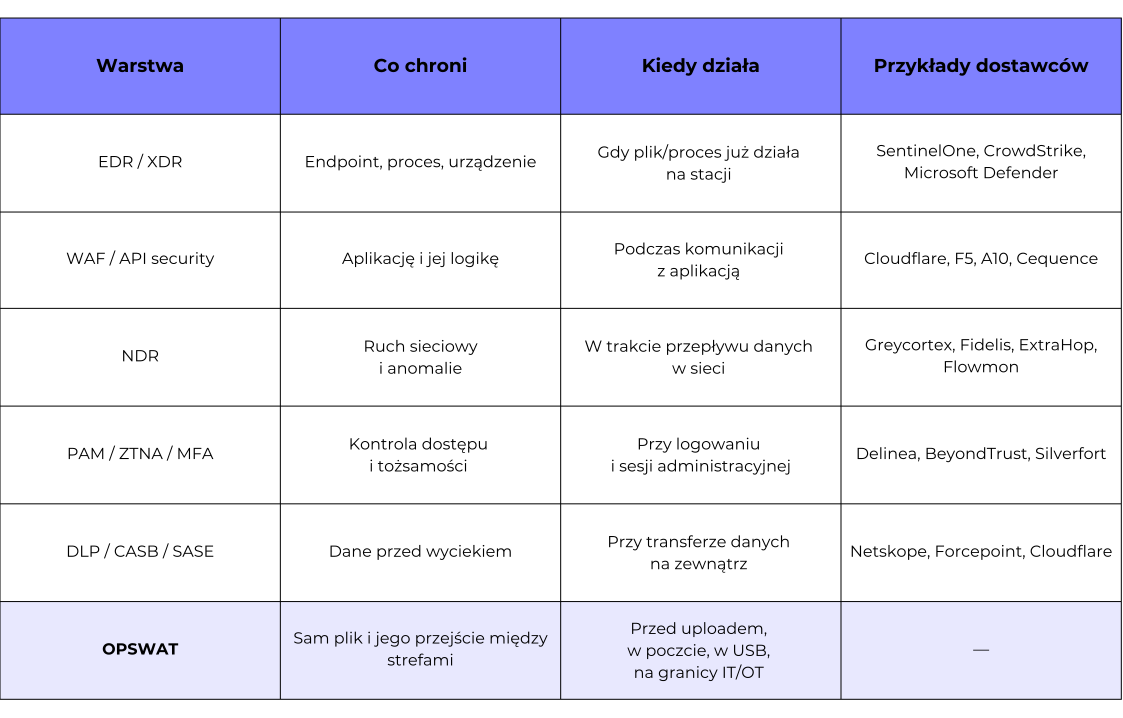
As a result, a malicious file can be sanitized, blocked, or quarantined before it even reaches the system that would later have to detect and handle the incident.
If a company uses SIEM/SOAR systems or a SOC (Security Operations Center), OPSWAT can be an excellent source of file-related context that accelerates incident analysis.
How OPSWAT MetaDefender Differs from Traditional DLP
OPSWAT MetaDefender is sometimes confused with traditional DLP, but this is an oversimplification. Traditional DLP primarily answers the question of whether a file contains sensitive data that should not leave the organization. OPSWAT goes a step further and also asks: can this file be trusted at all?
A file may contain no personal data and still carry malicious code. It may also contain sensitive data while being completely “clean” from a malware perspective. OPSWAT combines both perspectives: it analyzes content for sensitive data while also removing active content, scanning with multiple engines, and verifying the file type before deciding whether the file can be allowed to move further in the process.
Key Use Cases
- Secure file uploads to applications, customer portals, forms, and public administration portals — wherever an external user can upload any file.
- Email and attachment protection — one of the most cost-effective points for implementing file-level control. Protection of file repositories, SharePoint, and cloud storage, where documents are stored and shared by many users over longer periods of time.
- Control of USB media brought in by service technicians and employees — crucial in industrial environments, where an operator workstation rarely has direct internet access.
- Secure file transfer between IT and OT, with control over who sent what and when, as well as protection of air-gapped environments, where transfers must take place in a controlled way despite the lack of a permanent connection to the external network. Control of supplier packages and components — an increasingly important topic in the context of supply chain security, especially since nearly half of analyzed breaches involve technology products or services originating from external suppliers.
Industries That Benefit Most from OPSWAT Implementation
- Industry and critical infrastructure — because of OT environments, USB media, service technicians, and isolated networks. The manufacturing sector has remained one of the most frequently attacked sectors for years, while organizations covered by NIS2/KSC (the National Cybersecurity System) increasingly need to demonstrate specific technical controls.
- Public sector — because of electronic inboxes, citizen-facing forms, and the large volume of personal data processed daily in digital service portals.
- Finance and insurance — due to the processing of documents from customers, brokers, and partners; DORA (Digital Operational Resilience Act) requirements further reward the auditability of such flows.
- Healthcare and pharmaceuticals — because of patient data, medical documentation, and data exchange with laboratories, where personal data protection and GDPR compliance go hand in hand with protection against malware in documentation.
- E-commerce, SaaS, and technology companies — because of user file uploads, customer portals, and storage shared across multiple clients, often subject to ISO 27001 requirements.
- BPO, HR, law firms, and consulting — because of the large number of documents received from external sources every day, often from previously unknown senders.
Summary
Files rarely make it to the front pages of security analyses, even though every day they serve as an entry gate into organizations, regardless of industry or company size. OPSWAT MetaDefender does not replace core technologies such as EDR, WAF, DLP, NDR, or PAM. It is a specialized layer that secures files before they become a problem for an endpoint, application, storage, email, OT environment, or business process. This means lower incident risk, safer processes, and greater auditability — increasingly required by regulations such as NIS2/KSC, DORA, and ISO 27001.
If you want to identify where your organization receives, sends, or stores files from untrusted sources, talk to 4Prime experts. We will help assess whether OPSWAT can strengthen your security architecture and how to integrate this technology with your existing solutions.
Text autor: